
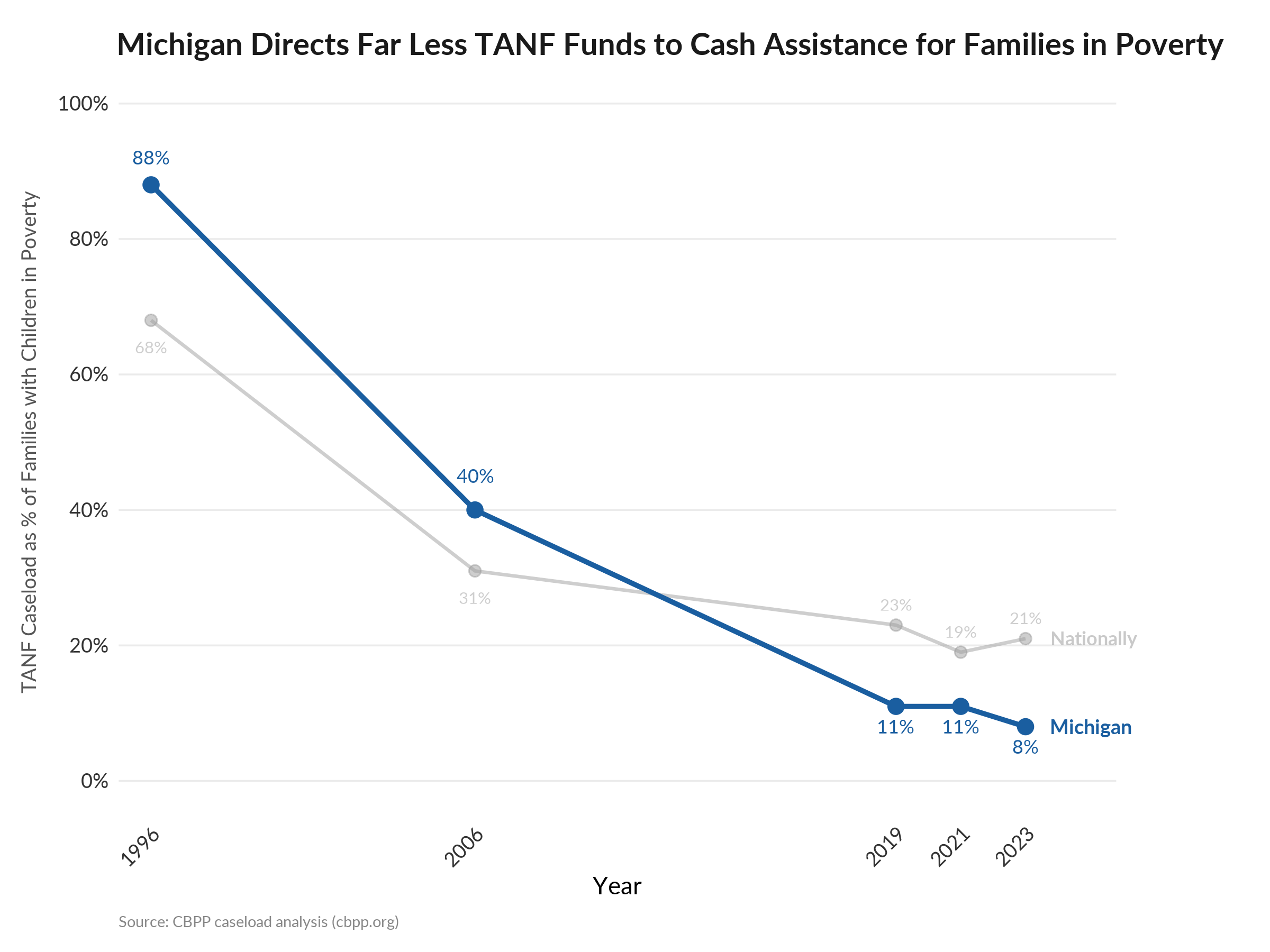
Temporary Assistance for Needy Families (TANF) is a fixed annual federal block grant designed to provide states with the resources to help low-income families with children achieve economic security. Since its creation in 1996, the program has evolved from a dedicated cash safety net into a flexible funding stream that states often divert to other budget priorities, leading to significant documented cases of misuse and a decline in direct family assistance. Nationally, TANF cash assistance went to 68 families for every 100 living in poverty in the US in 1996. By 2019, that ratio plummeted to just 23 families.
Michigan’s TANF Funds and the Decline of Cash Assistance
- Erosion of Federal Support: While Michigan receives a fixed $773 million annual federal TANF award, the grant has been frozen in nominal terms since its inception and has lost 51% of its value since 1997 due to inflation.
- Declining Reach: TANF cash assistance went to only 8 families for every 100 families with children under 18 living in poverty in Michigan in 2023.
- A Reshaped Safety Net: While federal programs like SNAP and EITC have expanded to help offset state-level TANF declines, they are centered on in-kind aid or annual tax refunds and fail to address the "consistent monthly cash" or unconditional needs of the most vulnerable families.
Michigan is an Expenditure Outlier
- Limited Direct Aid: As of Fiscal Year 2024, Michigan directs only 6% of its total TANF funding toward basic assistance (direct cash aid and vouchers), ranking 42nd among the 50 states and Washington, D.C. In the U.S., 22% of total TANF spending goes to basic assistance.
- Larger Diversion to Other Services: As of Fiscal Year 2024, Michigan spends 26% of its total TANF funds on “Services for Children and Youth,” which ranks 2nd among the 50 states and Washington, D.C.; only 3% of total TANF spending in the U.S. goes to this category. Michigan also spends 17% of TANF dollars on “Program Management,” which ranks 11th among the 50 states and Washington, D.C.; only 10% of total TANF spending in the U.S. goes to this category.
- Higher Operational Overhead: In Fiscal Year 2024, Michigan spent $2,700 on Administrative Costs per TANF recipient, which ranks 6th among the 50 states and Washington, D.C.
How is Cash Administered in Michigan?
Michigan administers direct cash assistance through the Family Independence Program (FIP), yet intensive front-end eligibility investigations, mandatory assessments, and middling benefit rates have contributed to a significant reach gap. In 2025, an average of only 31,533 individuals received monthly cash aid compared to over 1.4 million individuals who received food assistance. This disparity is sustained by a budgeting framework that leaves technology and monitoring expenditures unlimited, such that Michigan spends more than double the national average on bureaucracy and monitoring systems despite much lower rates of cash assistance.
Who Can Change This? The Legislature
Michigan’s TANF expenditures and eligibility requirements are uniquely determined through the budget agreement. Every dollar is appropriated by the legislature before being administered by the Michigan Department of Health and Human Services (MDHHS). MDHHS then submits a TANF state plan to the federal government to ensure compliance. The legislature has the direct authority to direct more TANF funding to direct cash assistance programs and to modify eligibility requirements by using the annual budget as a “time-limited addendum” to the Social Welfare Act.
The Evidence-Based Case for Greater Cash Assistance Programs
Direct cash support is effective and efficient.
- Cash for Kids → More Successful Adults: for low-income families, a $1,000 cash transfer in infancy results in: improved math/reading test scores in 3rd through 8th grade; a higher likelihood of high school graduation, and reductions in suspensions. More assistance leads to higher earnings and more hours worked by age 25.
- Pays for itself: among low-income families, infants who receive $1000 in cash transfers earn 1-2% more as adults compared to similar peers, and for males the effects are even higher (2-3%). These increased adult earnings eventually lead to additional tax contributions that exceed the initial transfer investment.
- Immediate Maternal Health Benefits: A $1,000 increase in TANF benefits for single mothers reduces instances of severe maternal psychological distress by 8.4%. For single mothers without a high school diploma, this same $1,000 results in a 26% reduction in instances of severe distress. Greater cash support also reduces rates of risky behavior like heavy drinking among single mothers.
- New Cash Pilots Demonstrate Promising Results: Evidence from contemporary unconditional cash transfer programs demonstrates that providing families with flexible cash has clear immediate benefits for the child and parents.
Facts Michigan Needs to Consider
1. Recognize Gaps in the Federal Safety Net: The federal safety net has changed. Pivoting towards regular cash-based assistance can provide poor families with the day-to-day flexibility that the federal safety net structure currently lacks.
2. Review Expenditure Priorities and the National Average: Michigan is near the bottom at prioritizing cash assistance through eligibility restrictions and limited benefits. This is not a partisan issue. States that prioritize basic assistance include Wyoming[CS2.1], South Dakota, Alaska, and New Hampshire.
3. Recognize Direct Transfer Programs have Significant ROI and Low Administrative Risk: Research shows significant long-term return on investment for direct-to-family transfers during infancy, since they can generate a negative net cost as children’s higher adult earnings eventually produce tax contributions that exceed the initial investment. Simplified, direct assistance models can mitigate the significant administrative risks inherent in complex service-delivery systems.
1. Pavetti, LaDonna, Ali Safawi, and Danilo Trisi. 2021. “TANF at 25: A Weaker Cash Safety Net Reaching Fewer Families and Doing Less to Lift Families Out of Deep Poverty.” National Tax Journal 74(3): 763-89.
2. Center for Budget and Policy Priorities. 2025. “TANF Is a Vital Resource for People Facing Hardship but Needs to Reach More Families”; recent numbers confirmed through our independent calculations.
3. Schmidt, Lucie, Lara Shore-Sheppard, and Tara Watson. 2025. "Did Welfare Reform End the Safety Net as We Knew It? The Record since 1996." Journal of Economic Perspectives 39 (1): 101–28.
4. Barr, Andrew, Jonathan Eggleston, and Alexander A Smith. 2022. “Investing in Infants: the Lasting Effects of Cash Transfers to New Families” The Quarterly Journal of Economics 137(4): 2539–2583
5. National Academies of Sciences, Engineering, and Medicine. 2019. A Roadmap to Reducing Child Poverty. Washington, DC: The National Academies Press.
6. Barr et al. “Investing in Infants”
7. Schmidt, Lucie, Lara Shore-Sheppard, and Tara Watson. 2023. “The Effect of Safety Net Generosity on Maternal Mental Health and Risky Health Behaviors.” Journal of Policy Analysis and Management 42(3): 706-736.
8. Sicong Sun, Jin Huang, Darrell L. Hudson, Michael Sherraden. 2021. Cash Transfers and Health. Annual Review Public Health. 42: 363-380.
9. Shah, H., Gennetian, L.A. 2024. “Unconditional cash transfers for families with children in the U.S.: a scoping review” Review of Economics of the Household 22: 415–450.
10. U.S. Department of Health and Human Services. “TANF and MOE Spending and Transfers by Activity, FY 2024.” TANF and MOE Spending and Transfers by Activity, FY 2024 | The Administration for Children and Families